
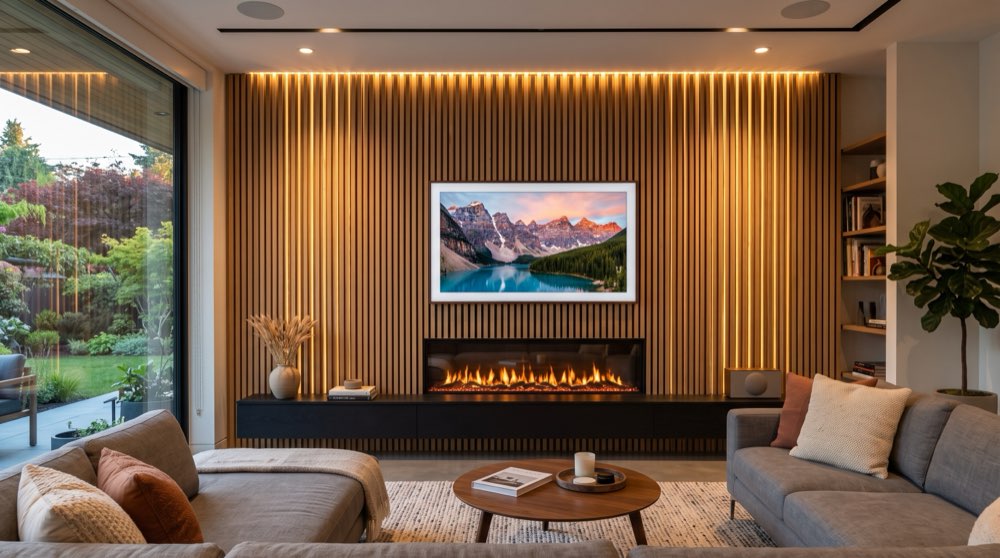
In modern residential architecture, the television wall is almost always the focal point of the living room. As screens have grown larger and thinner, managing how a TV interacts with your overall interior decor has become a primary challenge for homeowners. Throughout my fifteen years as an interior architect and media space planner, I have seen uninspired TV walls drag down beautiful living spaces, leaving a massive black screen hanging awkwardly on an empty drywall.
Designing a modern TV wall is about achieving visual balance. The goal is to integrate electronics into your room’s architectural narrative so the television complements your layout rather than dominating it. Whether your space calls for a warm vertical slat wood accent wall, a clean lime-wash plaster surround, custom fireplace built-ins, or an artwork-display screen framed by gallery prints, a well-designed TV wall elevates your entire home.
In this comprehensive guide, we will unpack fourteen creative living room TV wall ideas and built-in designs dominating modern homes in 2026. We will explore materials, cable concealment techniques, recessed niche framing, fireplace proportions, lighting integration, and low-profile media console pairings that turn your entertainment zone into a sophisticated architectural feature.
1. Vertical Oak Slat Wood Feature Walls
Vertical slat wood feature walls—often called acoustic wood paneling or tambour walls—have emerged as a premier TV backdrop trend. Constructed from narrow white oak, walnut, or black-stained wooden slats mounted over acoustic felt backing, slat walls introduce rhythmic vertical lines, rich warmth, and sound-dampening benefits to living rooms.
Mounting your television directly onto a vertical slat wood wall softens the harsh contrast of a black screen. When the TV is turned off, the screen blends into the dark shadows between wood slats, transforming your entertainment wall into a warm, textured architectural installation.
Run wood slats floor-to-ceiling across the entire wall width, or enclose a central TV alcove flanked by low media cabinets. Pair oak slat walls with concealed warm LED strip lighting washed down from a top ceiling cove to highlight natural wood grains during evening hours.
2. Integrated Linear Electric Fireplace and TV Surround
Combining a television and a linear electric fireplace on a single accent wall creates the ultimate cozy entertainment center. In modern homes, linear electric fireplaces (such as Dimplex or Touchstone units) offer clean flame effects without requiring gas lines or expensive chimney venting.
When designing a dual TV and fireplace wall, vertical proportion is critical. Build a bump-out drywall stud frame clad in smooth plaster, Venetian stucco, or tile. Position the linear fireplace near floor level, and mount the television 8 to 12 inches directly above the fireplace opening.
Ensure the width of the fireplace matches or slightly exceeds the width of your television screen. A fireplace that is narrower than the TV above it creates a top-heavy, unbalanced appearance. Recessing both the TV and fireplace flush into the drywall frame yields a sleek, luxury hotel aesthetic.
3. Seamless Plaster and Limewash Accent Walls
For minimalist, Scandinavian, or organic modern living rooms, a smooth plaster or limewash TV wall offers quiet, understated luxury. Limewash and Venetian plaster finishes utilize natural lime and mineral pigments to create soft, suede-like movement across walls.
Choose warm neutral plaster tones—such as creamy greiges, sandy taupes, or muted stone grays—that absorb glare without washing out. If you are exploring soft backdrop colors, consult our detailed analysis of the best living room paint colors to select luminous paint formulas that complement plaster finishes.
Pair a limewash TV wall with a low-profile white oak media sideboard. Mount the TV flush against the plaster surface, concealing all power and HDMI cables inside the wall cavity for an ultra-clean, wire-free visual plane.
4. The Samsung The Frame TV Gallery Wall Integration
Samsung’s The Frame TV revolutionized entertainment design by disguising a 4K television as museum-quality framed artwork when turned off. Featuring a matte anti-reflective screen, customizable wooden bezels (in white oak, walnut, or black metal), and a single translucent slim-connect wire, The Frame blends seamlessly into gallery wall layouts.
Surround your artwork-display TV with physical framed art prints, architectural photos, and sketches. Match the digital mat width and bezel color of The Frame TV to your physical picture frames, creating a unified art wall installation.
If you are planning an art wall arrangement around your screen, explore our pre-measured layout templates in living room gallery wall ideas for frame spacing rules that blend digital screens into physical art displays effortlessly.
5. Custom Asymmetrical Built-In Cabinetry and Floating Shelves
Custom built-in cabinetry provides the ultimate storage and display solution for entertainment walls. Rather than installing rigid symmetrical cabinets on both sides, modern interior design favors asymmetrical built-in layouts that feel casual, architectural, and custom-tailored.
Position closed storage cabinets on one side of the TV (to hide electronics, board games, and cables) and balance the opposite side with open floating wood shelves styled with ceramic vessels, hardcover design books, and greenery.
Incorporate warm LED strip lights underneath floating shelves to illuminate styled decor during evening hours. Asymmetrical built-ins break up heavy boxy layouts, adding rhythmic visual balance to open floor plans.
6. Dark Moody Accent Walls (Charcoal, Navy, and Dark Green)
If you want your television screen to disappear completely when turned off, paint your TV accent wall in a rich, dark paint color. Dark colors absorb light and erase the boundary between a black glass screen and the surrounding wall surface.
Deep charcoal-browns (such as Sherwin-Williams Urbane Bronze), dark forest greens (such as Farrow & Ball Studio Green), or moody navies serve as dramatic TV backdrops. Paint walls, baseboards, and surrounding trim in the same dark color using a matte or eggshell finish.
Contrast a dark TV wall with a warm caramel leather sofa, natural white oak floors, and warm unlacquered brass lighting fixtures. The dark backdrop eliminates glare and creates an intimate, cinematic den atmosphere during evening movie nights.
7. Floating Low-Profile Media Consoles
Wall-mounted floating media consoles elevate storage off the floor, leaving open floor space visible underneath. Seeing floor space extend beneath a media unit makes small and medium-sized living rooms feel instantly airier and larger.
Choose a long, slender floating console constructed from white oak, walnut, or fluted wood. Mount the unit 8 to 12 inches above the floor, ensuring the console width spans at least 12 to 24 inches wider than the television screen above it.
A floating console provides a clean horizontal anchor while housing surge protectors, cable boxes, and streaming devices inside push-latch cabinet doors. Tuck warm LED strip lights underneath the console to cast a soft glow across the floor surface.
8. Recessed Niche TV Framing with Concealed Cabling
Mounting a television flat on a dry wall causes the screen profile to project several inches out into room space. Building a shallow recessed drywall niche allows the TV screen to sit completely flush with the surrounding wall plane.
Frame a drywall niche that is 2 inches wider and taller than your television dimensions, and 4 to 6 inches deep. Install an articulated ultra-slim TV wall mount inside the niche so the screen can be pulled forward or angled toward seating areas when needed.
Run in-wall rated power outlets and HDMI conduit pipes behind the niche. Recessing the TV flush with drywall creates a tailored, high-end architectural finish that looks integrated into the home’s original blueprint.
9. Stone Tile, Porcelain Slab, and Marble TV Feature Walls
claddings—such as large-format porcelain slabs, honed travertine tile, slate, or stacked stone—introduce geological luxury and dramatic texture to living room TV surrounds.
Large-format 4×8 foot porcelain slabs (mimicking Calacatta marble or dark Nero Marquina) provide a seamless, grout-free stone wall that catches light softly. Mounting a television directly onto a polished or honed stone slab creates a high-end penthouse aesthetic.
Pair stone TV feature walls with low-profile upholstered seating and low-glare lighting. If you are specifying seating to face a stone feature wall, review our comprehensive sectional sofa buying guide to choose fabric textures that complement natural stone surfaces.
10. Concealed Sliding Barn Door or Art Panel Cabinets
For homeowners who prefer to hide their television completely when entertaining guests or reading, concealed TV cabinets offer the ultimate disappearing act. Sliding art panels or custom cabinet doors slide closed to cover the screen entirely.
Install two large framed canvas art prints or wooden slatted barn doors mounted on a smooth top-track mechanism. When closed, the artwork covers the TV screen, displaying a curated art piece above your mantel or console.
When it is time for movie watching, gently slide the art panels open along the track to reveal the screen. Concealed TV cabinets preserve a serene, tech-free atmosphere in formal living rooms.
11. Full-Height Floor-to-Ceiling Wood Tambour Panels
Tambour paneling consists of thin flexible wood strips glued to a cloth backing, allowing the wood to curve gracefully around corners and wall bump-outs. Full-height tambour TV walls bring rich curves and organic rhythm into modern living rooms.
Wrap tambour paneling around a central TV wall bump-out, curving the sharp 90-degree outer corners into smooth rounded edges. The soft curves diffuse light beautifully, softening rigid boxy room architecture.
Stain tambour wood panels in a low-sheen natural oak or smoked walnut finish. Pair with a low-slung sofa and organic decor elements to complete a warm modern aesthetic.
12. Biophilic Greenery and Open Floating Plant Shelves
Integrating live houseplants around your television wall introduces vibrant chlorophyll color, natural organic shapes, and air-purifying benefits to your entertainment space, softening electronic equipment.
Install open wooden floating shelves above and beside your TV screen, styling them with trailing Pothos, Philodendrons, or Snake Plants in terracotta and ceramic pots. Place a large potted indoor tree (such as a Ficus Audrey or Olive Tree) next to your media console.
If you want to explore how biophilic greenery elevates modern interiors, read our feature on organic modern living room decor ideas to discover plant styling tricks for living spaces.
13. Integrated Concealed Soundbar and Audio Nook
Sound quality is essential for an immersive entertainment experience, but bulky black audio speakers and tangled wires can ruin a sleek TV wall aesthetic. Modern design integrates audio equipment directly into wall cabinetry.
Build a shallow horizontal speaker niche directly beneath your TV screen, lining the niche front with acoustically transparent speaker cloth or wooden slat grilles. Place your soundbar inside the niche out of sight.
Concealing audio equipment preserves clean visual lines while allowing sound waves to pass through unhindered, delivering high-fidelity audio without visual clutter.
14. Budget-Friendly DIY Paint and Trim Geometric TV Feature
You do not need a massive renovation budget to create a stunning TV wall. Applying simple wood picture molding trim or creating a geometric painted accent wall delivers high-end architectural impact on a modest budget.
Attach affordable pine picture frame molding trim in rectangular boxes across your TV wall, and paint the entire wall and trim in a rich warm neutral or charcoal color. The picture molding creates subtle shadow boxes that frame your TV screen beautifully.
If you are planning an entertainment makeover on a budget, browse through our complete guide on budget modern living room design ideas for low-cost DIY wall transformation hacks.
Step-by-Step Guide to In-Wall Cable Concealment
Nothing ruins a modern TV wall faster than tangled black cords hanging down drywalls. Follow this simple step-by-step method to hide electronic cables completely:
- Use an In-Wall Cable Power Kit: Purchase a code-compliant in-wall TV power bridge kit (available at hardware stores for $25 to $40). This provides a recessed power outlet directly behind the TV without wiring into your main breaker box.
- Install a Flexible Conduit Pipe: Cut two 2-inch holes in the drywall—one behind the TV mount and one behind the low media console. Run a flexible plastic conduit pipe between the holes inside the wall cavity.
- Fish HDMI and Audio Cables: Pass your HDMI, optical, and Ethernet cables down through the conduit pipe. The conduit allows you to pull new cables through easily whenever you upgrade electronics.
- Cover Holes with Brush Wall Plates: Install clean white or black brush wall plates over drywall openings for a tailored, professional finish.
TV Mounting Height and Viewing Distance Rules
- Eye-Level Mounting Height: The center of your TV screen should sit at eye level when seated on your sofa—typically 42 to 48 inches from the floor to the screen center.
- Above Fireplace Mounting: If mounting above a fireplace mantel, angle the screen slightly downward using a tilt TV mount, or use a pull-down mantel mount that lowers the screen for viewing.
- Ideal Viewing Distance: Multiply your TV screen diagonal size by 1.2 to 1.5 to determine optimal seating distance. For a 65-inch TV, sit approximately 6.5 to 8 feet away from the screen.
- Console Width Ratio: Your media console should span at least 12 to 24 inches wider than your television screen to maintain visual weight balance.
Acoustic Soundproofing and Wall Panel Engineering
High-performance TV wall designs balance visual beauty with acoustic sound control. Hard drywall and glass surfaces reflect sound waves, creating flutter echoes that obscure dialogue clarity during movie watching.
Integrating acoustic wood slat paneling with dense recycled felt backing absorbs mid-to-high frequency sound waves, eliminating room flutter. Additionally, lining internal wall cavities with sound-dampening mineral wool insulation prevents television sound from transferring into adjacent bedrooms or home office spaces.
Smart Home AV Integration and Universal Remote Protocols
Streamline your entertainment wall by consolidating electronic controls into a single smart automation ecosystem:
- RF and Wi-Fi Smart Remotes: Replace multiple plastic remotes with a single RF/Wi-Fi smart remote (such as Logitech Harmony or Control4) that operates electronics inside closed cabinet doors.
- HDMI-CEC Auto-Switching: Enable HDMI-CEC on your TV and soundbar so powering on your gaming console or streaming box automatically switches audio and video inputs seamlessly.
- Concealed Smart Outlets: Plug media power strips into smart surge protectors, allowing automated power-offs during nighttime hours to save standby energy.
Thermal Safety Protocols for Fireplace TV Surrounds
When mounting electronics directly above a gas, wood, or electric fireplace, heat management is essential for protecting sensitive circuit boards from thermal damage. High temperatures can degrade TV screens and void manufacturer warranties.
Install a non-combustible floating mantel shelf (in stone, concrete, or steel) extending at least 6 to 10 inches forward directly beneath the television screen. The mantel shelf acts as a heat deflector, routing rising warm air currents away from the TV face. Always verify that wall surface temperatures behind the TV remain below 90 degrees Fahrenheit during active fireplace operation.
TV Wall Paint and Lighting Contrast Optimization
The paint color and lighting surrounding your TV wall dictate daytime screen visibility and nighttime viewing comfort. Selecting high-contrast or low-glare paint finishes enhances your home theater experience.
Apply a matte or flat paint finish across your TV accent wall to absorb ambient lamp reflections and window glare. Pair dark accent walls with soft bias lighting behind the TV screen. Bias lighting reduces eye strain caused by stark contrast between a bright TV screen and a dark room during evening hours.
Real-World Case Study: Transforming a Bland TV Wall
To demonstrate the practical impact of integrated TV wall design, consider a recent studio project involving a 1990s suburban home in Chicago. The homeowners had a large 75-inch TV screen mounted on a plain white drywall, surrounded by tangled black cables and an undersized 48-inch media console that made the room feel top-heavy and chaotic.
Our design team built a 6-inch drywall bump-out frame clad in vertical white oak slat wood paneling. We recessed the TV screen flush into a central alcove, installed an integrated 60-inch linear electric fireplace below, and routed all power and HDMI cables through in-wall conduit pipes.
We paired the oak slat wall with a long 84-inch floating media console in matte black finish, equipped with concealed warm 2700K LED cove lighting. The transformation was dramatic: cable clutter vanished, room acoustics improved, and the living room gained a warm, luxury hotel focal feature that anchored the entire home.
Frequently Asked Questions (FAQ)
1. How high should a television be mounted on a living room wall?
The center of the TV screen should sit at eye level when seated on your sofa—approximately 42 to 48 inches from the floor. Mounting TVs too high (near ceiling lines) leads to neck strain during extended viewing.
2. How do I hide television cables without cutting into drywall?
Use paintable plastic cable raceway channels. Attach the raceway channel to your drywall using adhesive backing, enclose the cords inside, and paint the channel the exact color of your wall so it blends into the background.
3. How much wider should a media console be than the TV above it?
Your media console should extend at least 6 to 12 inches wider than the television screen on both sides (12 to 24 inches wider overall) to establish a stable visual foundation.
4. Is it safe to mount a TV above a fireplace?
Yes, provided you manage heat. Electric fireplaces emit low heat forward, making them very safe for TVs above. For wood or gas fireplaces, ensure a mantel shelf deflects heat away from the TV screen and use a tilt or pull-down TV mount.
5. What is a slat wood TV feature wall?
A slat wood TV wall consists of vertical wooden slats (in oak or walnut) mounted over dark acoustic felt backing. It introduces natural wood warmth, sound-dampening acoustic benefits, and modern architectural texture.
6. What size TV is best for a medium living room?
A 55-inch or 65-inch 4K TV is ideal for medium living rooms with 7 to 9 feet of viewing distance between the sofa and the wall screen.
7. How does Samsung The Frame TV work?
Samsung The Frame features a matte anti-reflective screen that displays high-resolution digital artwork when turned off. It uses customizable wooden frames and a single translucent wire to blend into gallery walls like real art.
8. Can I mount a TV on a plaster or limewash accent wall?
Yes. Mount the TV wall bracket into wooden studs behind the plaster drywall before applying limewash or plaster finishes for secure weight support.
9. What color should I paint the wall behind my TV?
Dark colors (like charcoal, navy, or dark forest green) help black TV screens disappear when turned off. Warm off-whites or greiges provide crisp contrast if you use an artwork-display TV.
10. What is acoustic felt backing on slat wood panels?
Acoustic felt is a dense recycled felt backing attached to the rear of wooden slats that absorbs room echoes, improves sound clarity, and hides drywall surfaces between wood slats.